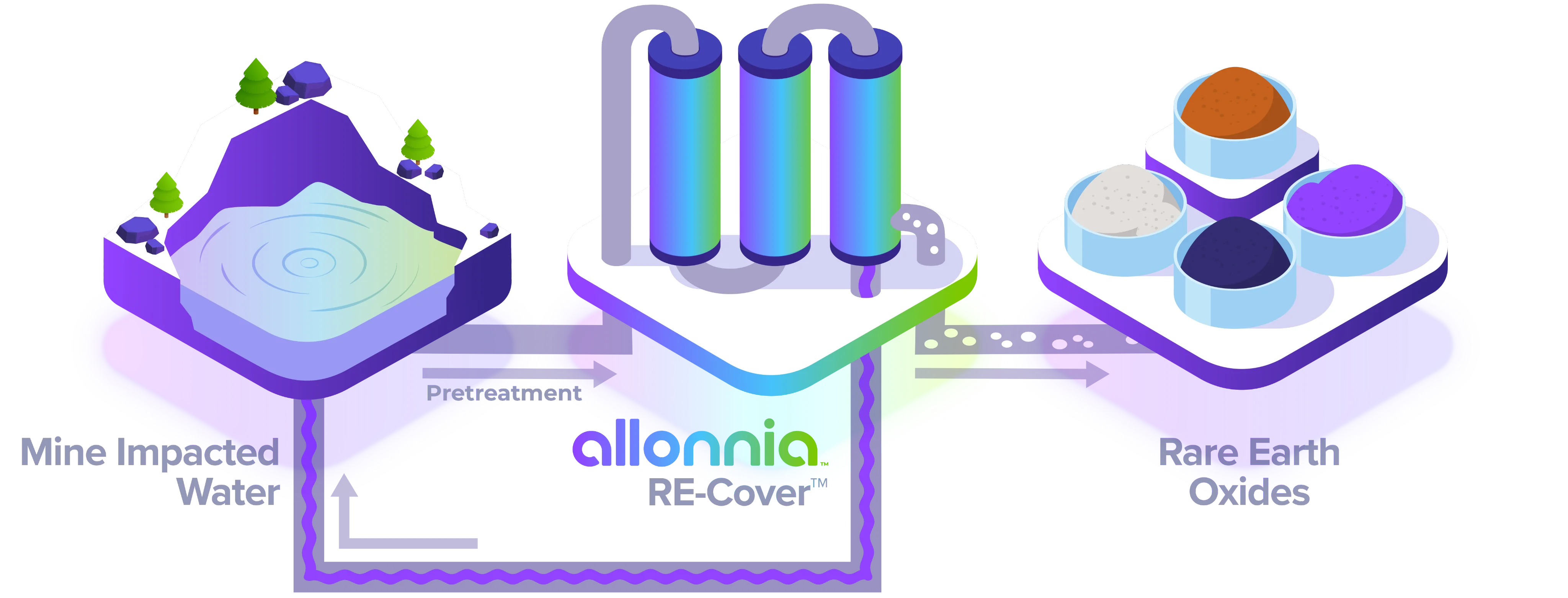
RE-Cover uses engineered proteins to bind rare earth elements from coal ash, tailings, and mine-impacted water. Modular systems, deployable per site, drawing on feedstock that’s already on US soil.
WHAT IT DOES
Allonnia
RE-Cover™
Rare earths, recovered from waste that already exists
RE-Cover is a modular biosorption system that pulls rare earth elements out of feedstock the country is already sitting on: coal fly ash, mine tailings, and acid mine drainage. The same Allonnia Biosolution™ platform that powers D-Solve takes a different form here, engineered proteins on a solid substrate, packed into columns the size of a shipping container. Feedstock flows through. The proteins selectively bind the rare earths and let everything else pass. A brief elution step releases the bound metals as a high-purity concentrate, ready for downstream refining.
The result is a domestic source of neodymium, praseodymium, yttrium, and other rare earths that the energy transition, the grid, and the defense industrial base depend on, recovered without opening a new mine. RE-Cover deployments are modular by design: each column installs in months, costs a fraction of a traditional rare-earth facility, and scales site by site as feedstock and demand grow.
Today’s customer is the operator sitting on a coal ash impoundment that carries compliance cost and no revenue. Tomorrow’s includes the mining company whose tailings and acid mine drainage hold value its current flowsheet can’t reach.
6 compelling benefits
Waste to value
The coal ash impoundment, the tailings pile, the AMD discharge that today is compliance cost and not much else. RE-Cover turns those waste streams into a feedstock for the rare earth supply chain, unlocking value from an asset that’s already on the balance sheet as a liability.
A domestic supply
Recovering rare earths from US soil shortens a supply chain that today runs through fewer hands than any other critical material. RE-Cover puts feedstock, processing, and product on the same continent as the customer.
Modular and low-capex
A traditional rare-earth facility is a hundreds of millions of dollars capital commitment. A RE-Cover module is a fraction of that, deployable per site, scaling site by site. The economics resemble a software rollout more than a mining build.
Precision separation
Engineered proteins bind rare earth elements and let everything else pass through. That selectivity holds even in dilute streams where conventional chemistry struggles, which is most of the feedstock RE-Cover is built for.
An ecosystem for deployment
Commercializing critical mineral recovery technologies requires feedstock, deployment sites, regulatory support, and committed partners. With state support and a coal ash Beneficial Use Designation partner, RE-Cover is positioned for real-world deployment.
Cleaner processing, by design
Protein-driven binding works at ambient conditions and without the strong acids and high-temperature steps a traditional rare earth circuit requires. Less chemistry, less energy, less waste to manage afterward.
WHERE WE ARE TODAY
Lab-validated.
Site secured.
Deployment path open.
RE-Cover is the second commercial product on Allonnia’s mining platform, two to three years behind D-Solve on the commercial trajectory and on the same path. Here is the work that’s happened to date.
Lab-validated at over 90% recovery and orders-of-magnitude purity gain
Engineered proteins selectively bind rare earth elements from realistic feedstock and release them on elution as a high-purity concentrate. The selectivity holds in extremely dilute streams, which is most of the material RE-Cover is built for.
First pilot site secured in Montana
One of the largest REE-bearing coal ash sites in the country. The impoundment contains more than 10 million tons of feedstock with approximately 388 parts per million of rare earth elements, including neodymium, praseodymium, and scandium, and has a Beneficial Use Designation for REE recovery.
Local government buy-in
Both the Montana Department of Environmental Quality and the Pennsylvania Department of Environmental Protection have issued letters indicating their support for the extraction of valuable critical rare earth elements from coal ash and acid mine drainage. The government support for commercial development is already secured.
Federal partnerships behind
the platform
RE-Cover’s underlying science has been supported through the US Army Corps of Engineers’ Engineer Research and Development Center (ERDC) and the Department of Defense’s Strategic Environmental Research and Development Program (SERDP). Two of the federal programs whose job is to fund the technologies the country can’t be without.
HOW IT WORKS
Feedstock in.
Rare earths out.
As many columns as the site needs.
Solution from your feedstock, whether it’s leachate from a coal ash impoundment, water from a tailings facility, or acid mine drainage from a closed site, is fed through a bank of RE-Cover columns packed with engineered proteins on a solid substrate.
The proteins selectively bind the rare earth elements while everything else passes through and returns to the source. A brief elution step releases the bound metals as a high-purity rare-earth concentrate ready for downstream refining. The substrate is regenerated in the same vessel and goes back to work. Sites start with the column count that matches their feedstock volume, and add columns as throughput grows. No high temperatures, no aggressive acids, no new equipment beyond the columns themselves.
Stage 1
Feedstock in
Coal ash leachate, tailings water, or AMD enters the column bank.
Stage 2
RE-Cover columns
Engineered proteins selectively bind the rare earths.
Stage 3
Rare earths out
A purified, ready-to-refine concentrate, on site.
WHERE THIS GOES
Proof of concept today.
Domestic supply tomorrow.
RE-Cover’s first deployment proves the model: coal ash to rare earths, on site. The potential of the business is bigger than that. The same modular platform, deployed across the thousands of coal ash and tailings sites already on the ground in North America, can stand up a domestic rare-earth supply from feedstock the country already owns.
A platform that
scales
The engineering stays consistent as the biology tunes to each feedstock, accelerating deployment at each site.
A material change in supply
A domestic source for rare earths that the grid, energy transition, and the defense industrial base depend on.
Liability turned to asset
Waste, that today carries compliance cost, becomes a valuable feedstock for a domestic supply chain.
Every site starts in the lab
Before RE-Cover ships to a site, the feedstock comes to us. Samples from a candidate site are characterized in our lab: feedstock chemistry, target rare earths, contaminants to design around. From there the biology is tuned to the specific stream and validated on the actual material, not a standard solution. By the time the columns arrive on site, the system has already been proven on the customer’s own feedstock.
TALK TO THE TEAM
Have a feedstock you think we should see?
Tell us what’s on your site. Coal ash, tailings, mine-impacted water, or something else we should know about. The fastest path to a useful answer is a sample and a few minutes with our team.