D-Solve uses biology to strip impurities out of your concentrate inside the flowsheet you already run, recovering more of the metal that’s in the ore you’re already mining.
WHAT IT DOES
Allonnia
D-Solve™
Removes what you don’t want, and keeps what you do.
D-Solve is a bolt-on process that uses targeted biology to dissolve the impurity minerals, the gangue, that travel with your valuable metal through the flowsheet. Remove the gangue and two things happen at once: the concentrate grade goes up, and metal that conventional processing would have lost in tails is recovered instead.
At the center of it is the Allonnia Biosolution™, a biologically derived solution selected and engineered to go after specific impurity minerals while leaving the metal you’re after untouched. That selectivity is the whole point, and it’s where conventional chemical and mechanical separation processes have reached their limits. D-Solve has demonstrated results on nickel, copper, and molybdenum concentrates, with lithium, zinc, and iron in active screening: the critical minerals the energy transition runs on.
6 compelling benefits
Higher recovery
Pull more payable metal from ore you’re already processing. By dissolving the impurity minerals that lock up your concentrate, D-Solve recovers metals that conventional processing sends to tailings.
Improved grade
A cleaner concentrate earns better terms. Stripping out gangue raises the grade and removes penalties like arsenic, lead and fluorine, so more of the mass leaving your site is the metal you actually sell.
Low-grade ore becomes viable
Ore zones too high in impurities to process economically today come back into play. Handling those impurities biologically extends the life of a deposit you’ve already permitted, developed, and paid for.
Bolt-on equipment
D-Solve works alongside the plant you already run. No flowsheet redesign, no capital rebuild, no waiting years for new infrastructure to come online.
A lower-carbon flowsheet
Removing impurities with biology displaces energy-intensive mechanical processing. Less energy and less carbon per tonne of metal follow from how the process works, not from a trade-off against performance.
Lower
cost
Fewer penalty elements at the smelter, less waste mass to transport, and more metal per tonne add up to a stronger margin on ore you’re already moving.
0:00
0:00·0:00
HOW IT WORKS
Three steps alongside
your existing flowsheet.
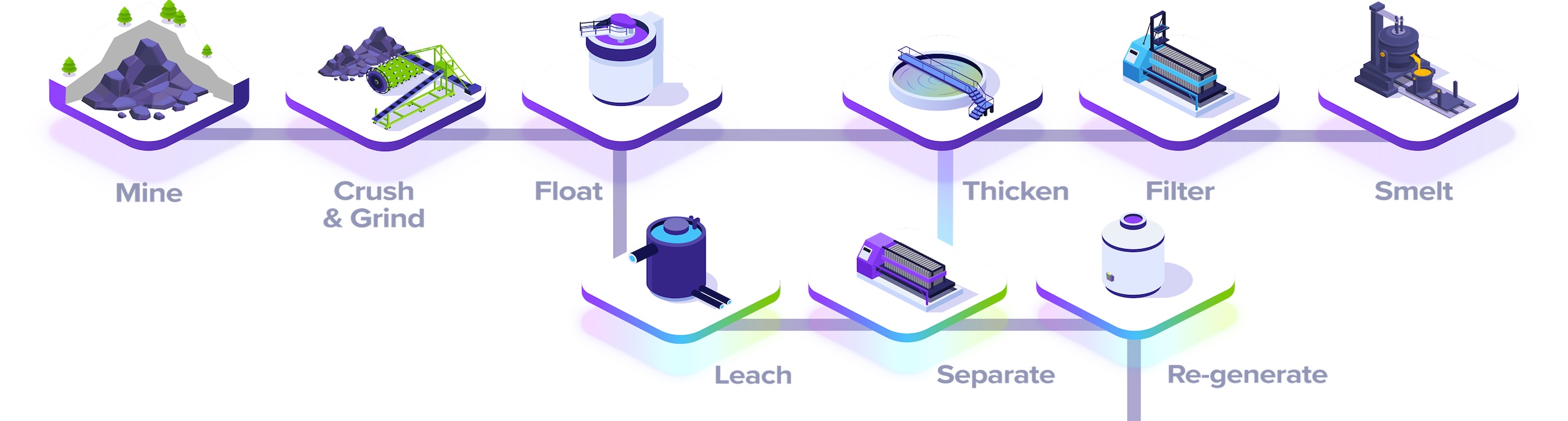
D-Solve runs as a self-contained loop between stages you already operate. The Biosolution does the work, then regenerates and goes back to work, so the process keeps running on the same charge.
Step 1
Agitated Leach
Your concentrate meets the Allonnia Biosolution™ in a stirred reactor. The biology selectively dissolves the target impurity minerals into solution and leaves the valuable metal in the solids, where you want it.
Step 2
Solid-Liquid Separation
The upgraded concentrate, now cleaner and higher grade, is separated from the impurity-laden liquid using conventional equipment. The solids move on through your flowsheet; the liquid carries the dissolved impurities away.
Step 3
Biosolution Regeneration
The spent liquid is processed to strip out the captured impurities and restore the Biosolution, which returns to the front of the loop. Regenerating and reusing the biology is what keeps operating cost and waste low, run after run.
One continuous loop.
Cleaner concentrate out, impurities removed,
biology back to work.
“D-Solve is really the first technology that we’ve come across that
meaningfully reduces that MgO content in our nickel concentrate.”
Hugo Staton
Mill Manager, Eagle Mine
Eagle Mine, in Michigan, is the only active nickel mine in North America. The first mobile D-Solve unit was deployed and operated there through a completed pilot.
PROVEN, NOT PROMISED
Demonstrated in production conditions, not just the lab.
D-Solve isn’t a concept waiting on its first trial. The process has run on real concentrate, at a working mine and in continuous demonstration, with the safety and performance record to back it.
Zero safety incidents
Zero
across the Eagle Mine pilot
safety incidents across the Eagle Mine pilot
Operated under MSHA oversight
MSHA
with no violations, citations, or reportable incidents identified
Operated under MSHA oversight with no violations, citations, or reportable incidents identified
~30 tonnes
~30t
of concentrate processed through the first mobile unit
30% cut in magnesium impurities
30%
in a five-day continuous run against a 25% target, with the Biosolution recycled throughout and no loss of performance
cut in magnesium impurities in a five-day continuous run against a 25% target, with the Biosolution recycled throughout and no loss of performance
WHERE THIS GOES
One mine today.
The rest tomorrow.
What D-Solve does at one site, it can do across an industry: lift production from ore already being mined, cut the energy and carbon spent getting metal out, and turn low-grade and penalty-laden material into value. Proven at pilot, the next step is scale.
More metal
from existing operations, with no new mines
Less energy
fewer mechanical and chemical steps per tonne
Unlock value
low grade zones can be exploited, penalty elements are removed but not turned to advantage
GO DEEPER
The science, in full
Our technical paper, Selective Gangue Mineral Dissolution, lays out the mechanism, the flowsheet, and the pilot data behind D-Solve.
Every deposit is different. Tell us what you’re processing and where the impurities are costing you, and our team will walk you through what a screening on your material would show.